
Behind the Scenes: 2026 NSCA National Conference
Forty Years Later... and Still Learning
By Joe “BIG HOUSE” Kenn

Forty years!
That number hit me a little differently this year.
The 2026 NSCA National Conference marked my 40th year as a member of the National Strength and Conditioning Association, and after attending conferences across four decades, I can honestly say this year's event was one of the best I have experienced in a long time.
There was energy. Attendance appeared to be up. The exhibit hall had a buzz that reminded me of years past. Coaches were engaged, conversations were meaningful, and the presentations were outstanding. It felt like our profession was moving forward together again.
For me, the conference is never just about sitting in sessions. Coach Kevin "Yox" Yoxall, Steve "Gort" Gortmaker and I spent three days representing Dynamic Fitness & Strength, where traffic at the booth remained steady throughout the conference. Between booth responsibilities, committee meetings, reconnecting with longtime friends and meeting the next generation of coaches, there never seemed to be a quiet moment.

As someone fortunate enough to serve on the Football, Powerlifting and Strongman Special Interest Groups, conference week is always busy. One of the biggest highlights was seeing the Football SIG continue to gain momentum under Jon Lynch's leadership. I've served the NSCA in many capacities over the years, and I have tremendous respect for the passion and commitment Jon has brought to the organization. It shows.
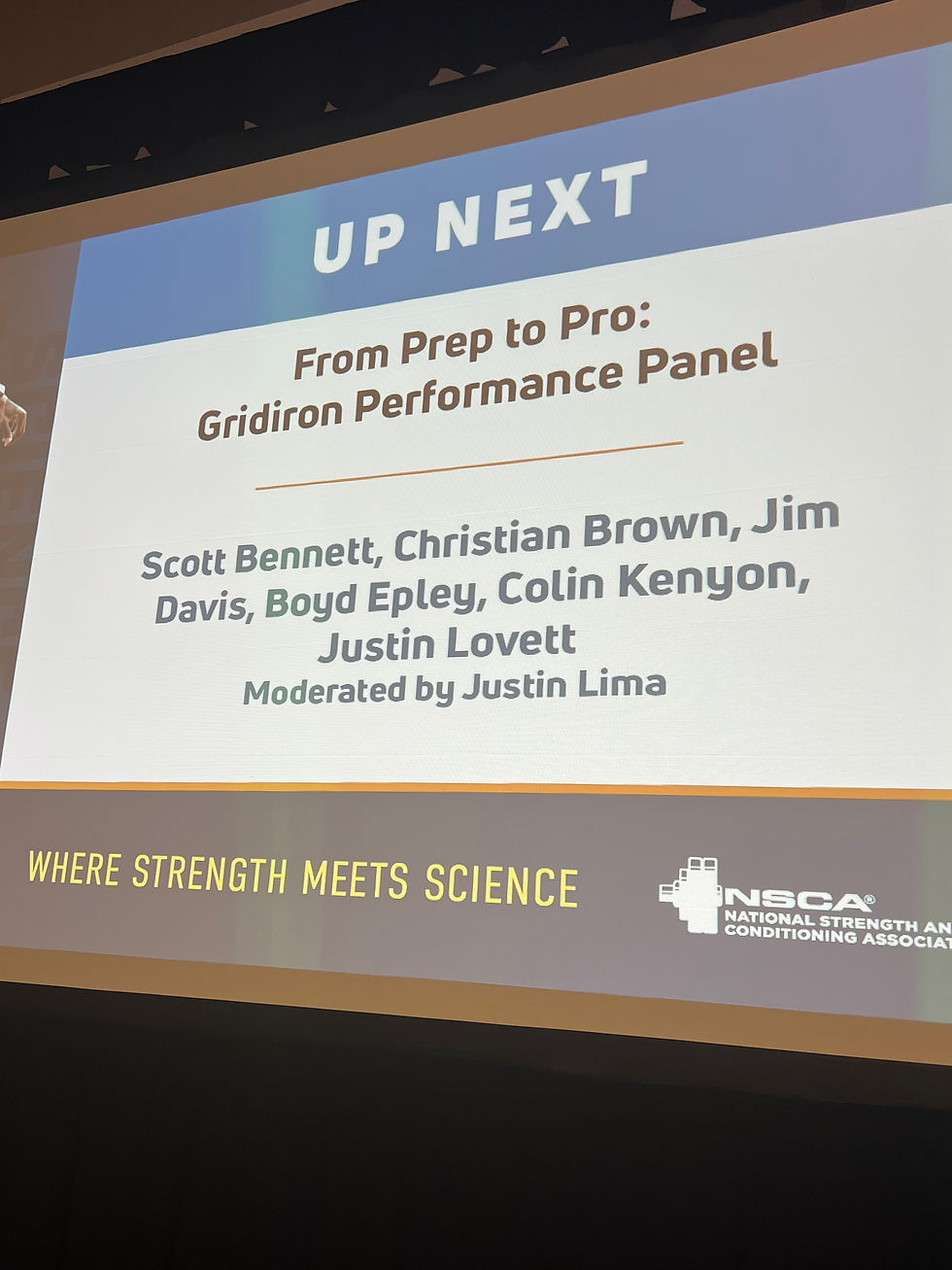
That leadership was evident during the Football SIG's inaugural pre-conference event. The opening panel brought together coaches representing the FCS, Division III, junior college, high school and NFL levels, along with one of the true pioneers of our profession, Boyd Epley. Listening to decades of coaching experience shared from multiple perspectives reminded everyone in attendance that while technology evolves, leadership and relationships remain at the heart of coaching.
Highlight Speaker: Justin Lovett, Los Angeles Rams

Every conference has one presentation that stays with you long after you've returned home. This year, for me, that presentation belonged to Super Bowl Champion Justin Lovett of the Los Angeles Rams. Coach Lovett challenged the audience with a simple question that immediately grabbed everyone's attention: If you were starting from scratch with a clean canvas, what four pillars would you build your strength and conditioning program around? It's a question every coach should ask themselves because it forces you to identify what truly matters instead of simply doing things because "that's how we've always done it."
Coach Lovett's first pillar centered on Transparent Intent and Alignment, and I found myself nodding throughout the discussion. Athletes buy into programs when they understand the "what," the "why," and the "when." Clear communication builds trust, trust creates alignment, and alignment ultimately leads to better performance. One point that really resonated with me was his emphasis on eliminating surprises. Whether you're working with athletes, sport coaches, sports medicine, nutrition, or performance science, everyone should be rowing in the same direction. A coordinated performance system always outperforms separate departments operating independently.
His second pillar focused on Proper Periodization Strategies, an area that has obviously been close to my heart throughout my career. Rather than advocating for one particular programming model, Coach Lovett challenged coaches to understand the demands of their environment before selecting the right approach. Linear, undulating, conjugate, block, triphasic, velocity-based training—they all have value when applied appropriately. The goal isn't to become loyal to a methodology; it's to become loyal to the athlete. Safe, effective, repeatable, athlete-specific programming that is built backward from competition should always be the objective.
The third pillar addressed Group-Appropriate Implementation, and it shifted the conversation from programming to people. Great systems still require great staffs to execute them. Coach Lovett encouraged coaches to honestly evaluate who is in their stable, what strengths each staff member brings to the organization, and whether the environment allows those individuals to perform at their highest level. I especially appreciated his horse racing analogy. Elite staffs, much like elite racehorses, need the right people, the right preparation, and the right track conditions if they expect to win consistently. It was a reminder that culture isn't something you talk about—it's something your staff demonstrates every day.
The final pillar, Scalable Individualization, may have been my favorite because it addressed one of the biggest challenges facing today's performance coaches. We all want to individualize training, but with large rosters that's often easier said than done. Coach Lovett presented the idea that true individualization isn't writing a different program for every athlete; it's creating flexible systems that allow coaches to make meaningful adjustments without disrupting the entire operation. His analogy of a DJ reading the room was outstanding. Sometimes you increase the volume, sometimes you adjust the bass, sometimes you fade into the next song—but the music never stops. Great coaches operate the same way. They constantly read the room, make subtle adjustments in real time, and meet athletes where they are without losing sight of the overall objective.
As I sat there listening, I couldn't help but appreciate how practical the entire presentation was. Coach Lovett wasn't presenting theory for theory's sake. He was sharing concepts that have been tested in one of the most demanding environments in professional sports. His four-pillar framework wasn't simply about building better football players—it was about building better performance systems. Those lessons translate whether you're coaching high school athletes, collegiate programs, private-sector clients, or professionals.
As I listened to Coach Lovett present, I found myself reflecting on how many of these concepts have influenced my own coaching journey. While our terminology and systems may differ, the underlying principles remain remarkably similar. Transparent communication, intentional programming, quality staff implementation, and the ability to individualize within a team environment are timeless coaching principles. Methods evolve, technology advances, but those fundamentals continue to separate good programs from great ones.
A Proud Dad Moment

As meaningful as the presentations were, nothing compared to watching my son speak on the national stage for the very first time.
He participated in a Career Center panel discussing internship best practices and did an outstanding job. As a father, it was difficult not to smile while watching him confidently share ideas with coaches from around the country.
The panel provided practical information for anyone developing internship programs, and I believe the resources the NSCA has created in this area will continue to benefit our profession for years to come.

Strongman News Update
The conference concluded with some personal news that means a great deal to me.
I was selected by the Strongman Special Interest Group Committee to serve as its new Executive Chair for the next three years. Having been involved with the sport of strongman in one form or another since the early 1990s, I am humbled by the opportunity.
Following leaders such as Heidi Campo, Chris Slater and Rick Howard is no small responsibility, but I'm excited to continue building the SIG and helping grow one of the fastest expanding disciplines within strength and conditioning.
Side Note:
One of the best parts of conferences in New Orleans, is the fellowship we have established with our early bird training sessions (5am leave the hotel) at the Westbank Athletic Club owned and operated by Coach Bum Lee. Bum and his entire family and staff take care of us like we are kings and queens of iron. The most hospitable people in the gym game. And the meals are no joke too. If you are ever in New Orleans and need a place to train, head to the Bank! Westbank Athletic Club that is.

Looking Ahead

As I made my way home and had a chance to reflect on another National Conference, I realized what keeps bringing me back year after year isn't simply the education. Yes, the presentations continue to challenge my thinking. The exhibit hall introduces new ideas and technology. Committee meetings provide opportunities to help move our profession forward. But after forty years, the greatest value still comes from the people.
This conference has always been about relationships.
It's about reconnecting with mentors who helped shape your career, catching up with colleagues you may only see once a year, meeting young coaches who are eager to learn, and watching the next generation begin making its own mark on our profession. Those conversations in the hallways, around the exhibit booths, and over dinner often become just as valuable as anything presented from the stage.
This year's conference reminded me why I became involved with the NSCA four decades ago. Our profession continues to evolve, but the foundation remains the same: coaches committed to helping athletes become better while continually striving to become better themselves. That's a culture worth investing in, and one I'm proud to continue serving.
Personally, I leave New Orleans energized. Watching my son present on the national stage, being elected as the next Executive Chair of the Strongman Special Interest Group, reconnecting with old friends, making new ones, and learning from outstanding coaches like Justin Lovett made this conference one I'll remember for a long time.
Now the countdown begins.
Next year marks the 50th Anniversary of the National Strength and Conditioning Association, and the profession will gather in one of my favorite cities—Las Vegas. I have a feeling it will be a celebration worthy of the milestone.
Until then, keep learning, keep sharing, keep challenging yourself, and never forget that our greatest impact isn't measured by the weight on the bar—i
t is measured by the athletes, coaches, and lives we influence along the way.
I'll see you in Las Vegas.
— Joe Kenn


From gentle slopes to treacherous trails, the game constantly demands maximum concentration from players to overcome obstacles and achieve new records. Snow Rider 3D