
BEHIND THE EVENT: AFCA National Convention │Joe Kenn, VP of Performance Education
American Football Coaches Association
January 11–13, 2026
Charlotte, North Carolina
Coach Joe “Big House” Kenn

The premier football coaches’ convention in the United States is the AFCA’s annual conference. For the second year in a row, the event was held in my backyard—Charlotte, North Carolina. While the AFCA Convention is understandably football-coach heavy, this year featured a collaborative effort with the NSCA (National Strength and Conditioning Association), which provided a dedicated strength and conditioning track.
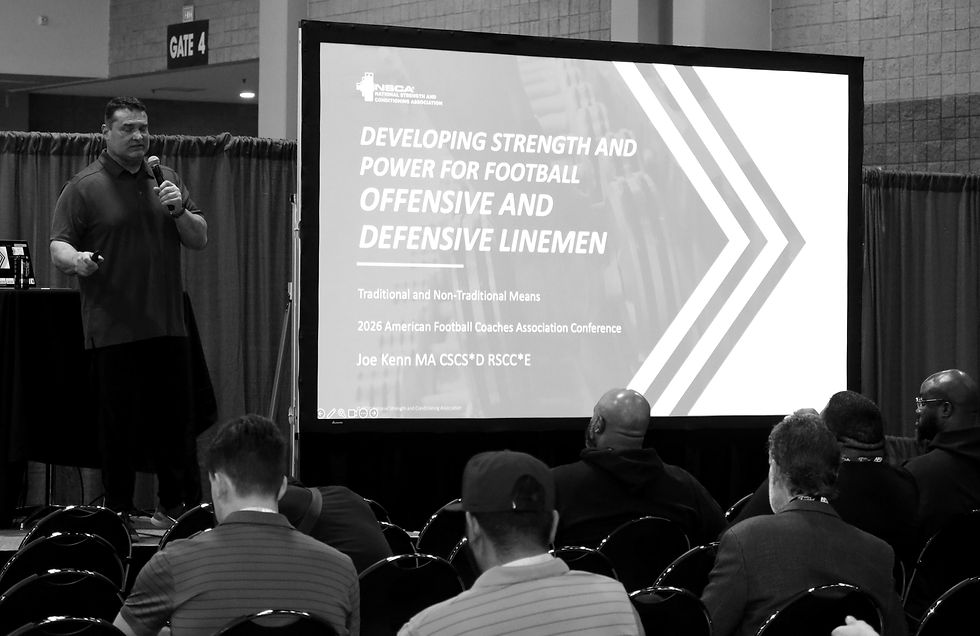
I was fortunate to be one of the coaches selected to present to football coaches interested in developing stronger, more durable athletes. The NSCA provided five speakers, offering a combination of hands-on skill and drill sessions along with classroom-based educational presentations. The audiences were highly engaged, and each presenter delivered practical information that could be readily adapted to programs at any level.

One of the greatest values of events like the AFCA Convention is the in-person, face-to-face networking that occurs throughout the exhibit hall and corridors of the convention center. These relationship-building opportunities often play a critical role in future employment and professional growth. With packed schedules that include position-specific sessions, program culture discussions, scheme and strategy presentations, and conference meetings, it is always an honor to contribute—even in a small way—to such a comprehensive educational environment.
Speaker Spotlight Series
One goal of this blog series is to highlight at least one speaker from every clinic I attend. This year, I chose to spotlight two presenters whose messages resonated deeply:
Martin Rooney, Owner, Training for Warriors
Quincy Johnson, Exercise Physiologist, University of Kansas Jayhawk Performance Lab
From Great Coaching to Culture
Coaching, Belief, and the Blueprint for Culture That Lasts

Martin Rooney
Owner, Training for Warriors
One of the greatest responsibilities of coaching is belief. Not motivational quotes. Not slogans on the wall. Belief that changes behavior. As emphasized during Martin Rooney’s presentation, a coach’s primary job is to get people to believe—first in the mission, then in the process, and ultimately in themselves.
But belief is not something you demand. It is something you model.
Coaches Create Belief Before They Create Results
A powerful question was posed early: Name one person who changed your life. For most of us, the answer is a coach, teacher, or mentor—someone who saw more in us than we saw in ourselves.
That is the power of coaching. Coaches don’t just teach skills; they light fires. They create energy, enthusiasm, and momentum. But the fire must exist in the coach first. You cannot give belief you do not possess.
Athletes know immediately whether a coach truly believes in what they are asking others to believe in. Leadership becomes a test—and a leap of faith. If the coach does not buy in fully, neither will the team.
Coachability Is More Than Compliance
Coachability is often misunderstood as obedience: “I tell you what to do, and you do it.” That is not coachability—that is compliance.
True coachability is openness. It is a willingness to be challenged, to be uncomfortable, and to grow. It applies to players and coaches alike. The best coaches remain teachable, adaptable, and grounded in their core beliefs.
This is where humility matters, highlighted by a powerful reminder:
“Don’t try to drown the person who taught you how to swim.”
Never forget the mentors, assistants, players, and staff who supported your climb. Success does not erase responsibility—it increases it.
Clarity Is Power
One of the most important leadership truths shared was simple: Clarity is power.
Athletes do not need more information; they need clear expectations. Decisive language. Detailed standards. Consistent messaging. Confusion creates hesitation. Clarity creates confidence.
When expectations are clear, accountability becomes fair. When standards are defined, culture has a chance to take hold.
The Coach as a Custodian
A coach is not an owner. A coach is a custodian.
The responsibility is to leave the program better than it was found—systems, standards, people, and relationships. Coaching is service. It is stewardship. And it requires thinking beyond wins and losses to long-term impact.
Rethinking “Culture” — Making It Usable
Like many coaches, I have struggled with the term culture. It has become vague, overused, and often meaningless. It can mean everything—or nothing.
What made this presentation valuable was the clarity of structure around culture. Rather than buzzwords, culture was broken into three actionable components:
1. People – Who We Are Values, character, and identity. People-centered cultures prioritize relationships, trust, and shared purpose.
2. Behaviors – How We Do It
Beliefs are invisible until behavior shows up. Standards, habits, discipline, and daily actions determine whether values are real or simply talked about.
3. Beliefs – What We Stand For
Beliefs drive behavior. What you believe determines how you act—especially under pressure.
Together, these three elements create a living, breathing culture—one capable of withstanding adversity, success, and change.
Champions and Vultures
Every culture has leaders—and every culture has threats.
Culture champions protect standards, model behavior, and lead when it is uncomfortable. Culture vultures resist accountability, undermine standards, and recruit followers. They are never alone and feed off negativity.
Coaches must decide: coach them up or coach them out. Ignoring them is not leadership.
Players and coaches alike can be champions or vultures. The coach must be the strongest believer in the room.
Culture Is Built Through Consistency
Culture is not installed—it is nurtured.
It grows through consistent behavior, repeated expectations, and daily reinforcement. When done correctly, culture steadies the ship during adversity and sustains performance through highs and lows.
In the end, coaching is service. It is belief in action. When people, behaviors, and beliefs align, culture stops being a buzzword and becomes a competitive advantage.
Culture, Standards, and the Science Behind Football Performance

Dr. Quincy Johnson
Exercise Physiologist, University of Kansas Jayhawk Performance Lab
Sustained success in football is not built on isolated tactics, technology, or single-season solutions. It emerges from the deliberate integration of culture, standards, and applied sport science into a unified performance model.
Culture forms the foundation—the shared behaviors, beliefs, and daily habits that define a program. High-performing environments emphasize collective commitment (we over me), accountability, pride in preparation, and the willingness to strain through adversity. Culture is not aspirational language; it is demonstrated through consistent actions and expectations over time.
Standards provide the structure that allows culture to function. Discipline, order, attention to detail, and leadership translate values into repeatable behaviors. Clear standards align effort with performance goals and remove ambiguity—allowing athletes and staff to focus on execution.
Sport science is most effective when it follows a clear progression: knowledge development → knowledge management → knowledge translation
Research and data only create value when properly interpreted and applied within the real-world constraints of the sport. The gap in football performance is rarely a lack of information—it is the challenge of translating science into practical, impactful decisions.
Ultimately, successful programs balance trust, impact, and opportunity. Trust is earned through consistency and transparency. Impact is created through intentional action. Opportunity is maximized when science supports—rather than replaces—coaching expertise. When culture and standards align with applied science, performance systems become sustainable, adaptable, and resilient.
Gallery
Best success and #WORDSWIN,
Coach Joe Kenn

60 Second Strength Coach

Get straight to the point with our 60-second strength training insights. Our concise videos cover theory and application for strength training pros and dedicated weightlifters alike. Start watching for instant inspiration now.

Snow Rider keeps players engaged with increasing difficulty and endless replay value.
About Monkey Mart, the gameplay is simple but addictive, focusing on farming, stocking shelves, and serving customers.